The contemporary celebration of La Purísima ranks among Nicaragua’s most significant holiday seasons, alongside Christmas and Holy Week. In a context marked by political unrest and the regime's ongoing suppression of public religious celebrations, I aimed to learn about and document the practices of La Purísima as they were being practiced in 2024. News reports indicate that religious traditions during Holy Week have long been banned, while the observance of La Purísima has faced increasing restrictions since 2018.
I acknowledge my personal connection to this devotion, which I view not as a limitation but as an advantage for conducting research. My perspective provides access to lived experiences, oral histories, and cultural nuances that enrich this study’s understanding of La Purísima and its enduring significance. I interviewed both the laity and clergy in various cities to explore oral histories and the political obstacles that persist within communities. I recorded, documented, and digitally captured the trip, not because I believed I could preserve an entire tradition through my work, but because I wanted to understand what people were practicing, remembering, and passing on in that historical moment.
Nicaragua has a deep-rooted devotion to the Immaculate Conception, the belief that Mary was conceived without sin. She is venerated today as the patroness of the country. In Nicaragua, the celebration of the Immaculate Conception lasts for 11 days. Each town in the country has its own unique artistic style of depicting the Virgin under this title, alongside thier own distinct traditions that unfold over those 11 days.
In the video, I include a clip of La Gritería, which originated in León. In 1857, nuns set up an altar outside a church to showcase the statue for the feast day. While they arranged the altar, they laughed joyfully. The Monsignor stepped outside and asked them, “¿Quién causa tanta alegría?” meaning “Who causes so much joy?” The nuns enthusiastically replied, “¡La concepción de María!”
CREATION PROCESS & REFLECTION
In my previous blog post, I introduce video essays as a film genre. The last five weeks have been enlightening, as I have learned about video essays through assigned academic literature and watching various examples.
Chris Marker’s The Case of the Grinning Cat (2004) and the video featuring Debbie Reynolds and Carrie Fisher offered two very different examples of a video essay. Watching them early in the course allowed me to explore freely because the examples were distinct from one another. Professor Oishi emphasized the importance of the creative process, adding a layer of comfort as I observed whatever outcomes emerged in creating the video essay. In our first screening of rough drafts, we viewed only two examples before the rest of the class presented the following week, which showcased the creativity possible within this genre.
At the beginning of the course, I planned to start my video essay by sitting in my living room and speaking into my Sony Alpha camera, purchasing a microphone, and renting a green screen room on campus. However, as time passed, I saw that I would not have enough time to follow through in my vision. As each day went by, my ability to sit in my living room with my camera was less and less possible. I did not have the bandwidth to narrowly follow my vision, but this self induced pressure for perfect is exactly what prevented me from beginning this type of project since I went to Nicaragua in 2024.
My creative process is usually lengthy. I tend to generate a lot of material, AND THEN remove, delete, and trim it down. I decided it was best to record my script and then rework it during the video creation process. This decision enabled me to begin right away instead of getting stuck on perfecting the script. The length of my script recording was 4 minutes and 58 seconds. As the days progressed, I could reflect on what I had recorded, think about it throughout the day, and edit accordingly. My fiancé also reviewed several edits and provided feedback, which was invaluable during the editing process prior to my class presentation. Because my workflow is to dump everything, it helped to talk through why it was okay to remove or shave off the script in specific parts. Throughout this process, I sat more and more with my desire, which I have had since my master’s program, to show my work visually. As I reflected on this daily, it became easier to let go of more and more of my script, ultimately using only 1 minute and 26 seconds of audio.
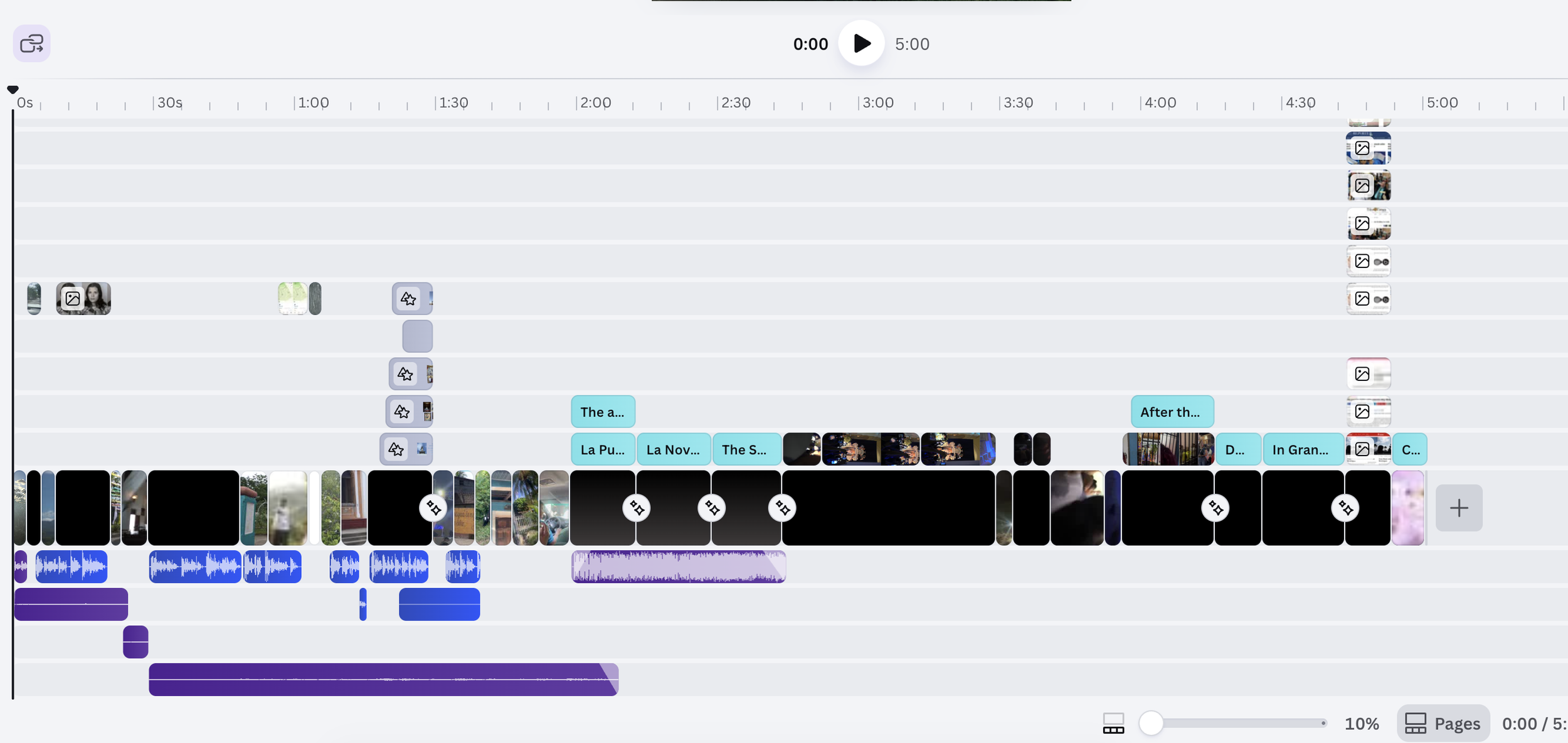
BLUE AUDIO DISPLAYING MY SCRIPT
Original recording: 4 minutes and 58 seconds
Final edit: 1 minute and 26 seconds
Not everything needs to be said. Sometimes the best approach is to show rather than tell, which has been my desire all along. This realization was significant for me, and I am grateful that I worked it out within myself during the creative process of building this film. Sometimes just quietly sitting with text, as at the end of my film, is more powerful.
Sarah Pink’s Analyzing Visual Experience and Georgina Kleege’s Blindness and Visual Culture helped me begin the creation process early, avoid becoming too fixated on any kind of initial visions. The texts also forced me to think beyond the visual and consider what it means to decenter the visual. These insights guided my thought process regarding the music selection and the emotions I wanted my film to evoke.
Although my video did not turn out to be the professional edit I had envisioned, nor did it feature the polished transitions of someone experienced in the field, it was authentically mine. I loved the fonts I chose and found the perfect songs to include, aligning “Por eso el Cristianismo” with the audio of us singing the same song during La Gritería.
Philip Lopate explains, “Even essays have plots!” (Page 119). To explain the devotion of the Immaculate Conception in Nicaragua, one must take time to clarify a few foundational elements. First, it is important to note that "La Purísima" is a title for the Virgin Mary and also refers to the 11-day celebration dedicated to her. Next, breaking down the details of this 11-day celebration requires extensive effort, as each of the three sections could honestly warrant a 45 minute powerpoint presentation of its own.
For this work, several foundations needed to be established. I explained why I traveled to Nicaragua, how I discovered this topic, and the significance of this devotion. Although I intended to present my narrative logically/linearly: 1) first discussing why Nicaragua, 2) how I encountered the devotion, and 3) an explanation of what the devotion entails, the reality of presenting this narrative is more complex. I did preliminary research on this devotion, so we planned a trip to Nicaragua so I could see it. In that sense, the exploration on this subject matter came first. HOWEVER, I went to Nicaragua because of my family heritage. My family shared this devotion with me, which is how I learned about it. My previous coursework centered on Marian studies, so I wanted to continue that pathway. HOWEVER EVER, I did not grow up learning or hearing about this devotion. It only came up in conversation when I asked my Tio Luis and Tio Polo for ideas on what I could study regarding religious devotions in Nicaragua for my PhD research at Claremont. In my workshopping of aiming for a linear timeline, I found resonance in several aspects of Paul Arthur’s “Essay Questions.”
“For starters, essays are not constructed around public personalities or the rehearsal of discrete events. Nor do they narrate the past from a neutral perspective following strict chronology, the domain of classical documentaries or contemporary spinoffs by Ken Burns and company. Instead, essays tend to blend several clashing time frames that layer what we think of as literary “tenses.” The impression of formal admixture is often extended by borrowing idioms from vérité, poetic, or problem films. As with literary essays, essay films may segue between separate styles, tones, or modes of address. In doing so, they fracture epistemological unities of time and place associated with documentary practices from John Grierson and thirties New Deal tracts through sixties vérité. The binding aspect of personal commentary is typically constituted by voiceover narration enhanced by musical selections, editorial as well as factual intertitles, and is often reinforced by compositional devices.”
This reflection on the nature of essays parallels my experience in creating my video. Maybe we are too quick to point out “clashing time frames” when actually a full picture is the one with layers.
To end, I want to say that I am shocked that I got to share my work with an entire class. I always wanted to create this video and I imagined it displayed on a platform that would reach no one. I am so happy to have had the opportunity to share my work, receive feedback, and edit it accordingly. Thanks to the warmly received feedback of my peers, I employed several edits to this film.
This project represented the first time I created something that effectively tells the story of why I am pursuing my research topic, how my discoveries came about, and the importance of sharing this narrative. This experience truly laid a foundation for my future work.